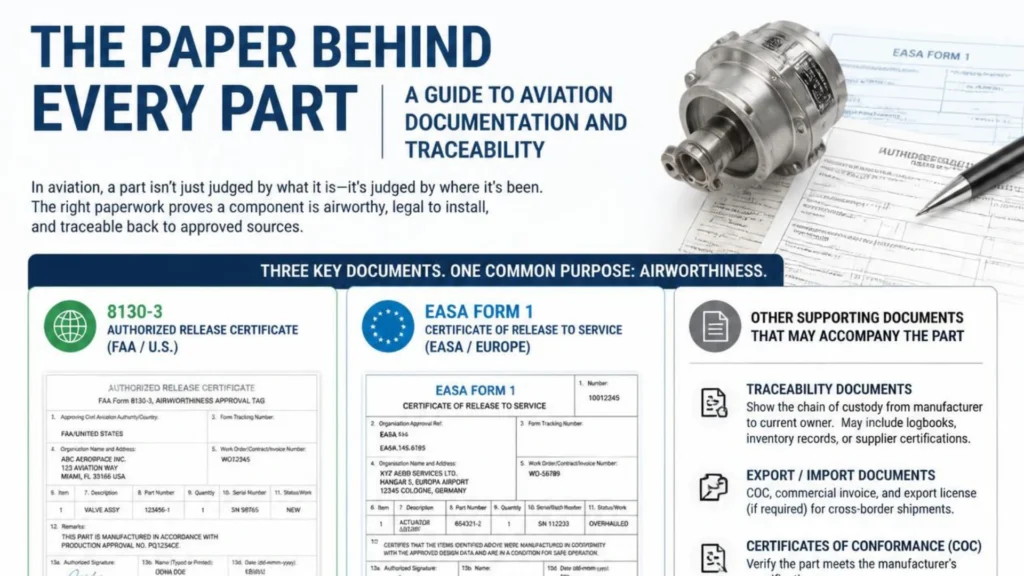
In aviation, a part is only as good as the paperwork that comes with it. A component can be physically perfect and still be unusable if its documentation does not prove what it is, where it came from, and that it is fit to fly. For procurement teams, learning to read this paperwork is as important as knowing the parts themselves.
This guide explains the core documents you will encounter and why traceability sits at the centre of every sound purchase.
Why paperwork carries so much weight
Aviation is built on the principle that every part fitted to an aircraft can be trusted. That trust is not assumed, it is documented. The paperwork accompanying a part is the evidence that it meets an approved standard and has an unbroken, verifiable history. Without that evidence, a maintenance organisation cannot legally or safely install it.
This is why an experienced buyer asks about documentation in the same breath as price and availability. The three are inseparable.
The core certification documents
Two documents appear again and again in parts transactions. They serve a similar purpose under different regulatory systems.
The 8130-3
This is an airworthiness approval tag issued under the United States regulatory system. It certifies that a part conforms to approved design data and is in a condition for safe operation. Depending on how it is completed, it can cover a newly produced part or one that has been inspected, repaired, or overhauled and returned to service.
The EASA Form 1
This is the European equivalent, issued under the European regulatory system. Like the 8130-3, it certifies conformity and airworthy condition. For operators working across regions, parts are often supplied with dual certification so they are acceptable to fleets under either system.
What these tags actually confirm
Both documents answer the same essential questions. Is this the part it claims to be? Does it meet an approved standard? Is it in a condition fit for installation? A tag that leaves any of these unclear is a warning sign worth pausing on.
Traceability: the history behind the part
Certification proves the part’s current status. Traceability proves its story. Traceability is the documented chain showing where a part originated and each significant step in its life, through overhaul, repair, and transfer of ownership.
Strong traceability matters for several reasons.
- It confirms the part genuinely came from a legitimate, approved source.
- It supports the certification, showing the tag reflects real history rather than sitting alone.
- It protects against parts of unknown or doubtful origin entering your fleet.
A part with clean certification but a broken history still carries risk. The best documentation tells a complete and consistent story from origin to your hands.
Matching paperwork to part condition
The documentation you should expect depends on the condition of the part.
New parts
Expect certification tracing the part back to production against approved design data.
Overhauled parts
Expect a certification reflecting the overhaul, issued by the organisation that performed the work to a defined standard, along with the history leading up to it.
Serviceable parts
Expect certification confirming the part was inspected and found fit for installation, supported by traceability that accounts for its prior service.
What a careful buyer checks
Before accepting any part, a diligent procurement team confirms a few things.
- The certification matches the part number and the condition being purchased.
- The certification is acceptable to the fleet’s governing regulatory system.
- The traceability is complete and consistent, with no unexplained gaps.
- The supplier can stand behind both the part and its documentation.
Sourcing parts with paperwork you can trust
At Airlink Spares, every part is supplied with the certification and traceability your fleet requires, matched to the condition you are buying. We treat documentation as inseparable from the part itself, because a component you cannot install is no help at all. If you need parts backed by paperwork you can rely on, our team is ready to support you.