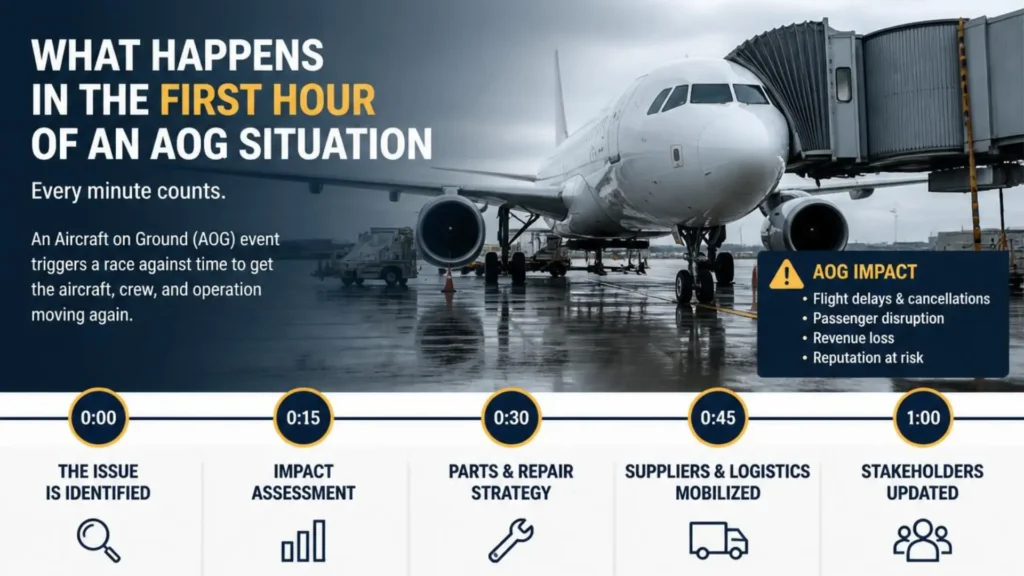
When an aircraft is on ground, every hour has a number attached to it. Grounded widebodies can cost tens of thousands of dollars per hour in lost revenue, crew disruption, and knock-on scheduling. The difference between a fast recovery and a costly one is usually decided in the first sixty minutes — before the part is even sourced.
Here is how an effective AOG response actually unfolds, and what to have ready before you ever need it.
Minute zero: the request goes out
The clock starts the moment your maintenance team confirms the fault and identifies the part number. Speed here depends entirely on how much information travels with that first message. A request that includes the part number, aircraft type, tail number, quantity, and required condition can be actioned immediately. One that says “need a pump, will send details later” cannot.
This is why serious operators keep a standing AOG contact channel open rather than starting from a web form. At Airlink Spares, urgent requests reach our team directly, and most receive an initial response within the hour.
The first 15 minutes: sourcing begins
With a clean request in hand, sourcing runs on several tracks at once:
- Stock check — is the exact part, in the required condition, available for immediate dispatch?
- Alternates — are there approved alternate part numbers or interchangeable units that satisfy the same requirement?
- Certification — confirming the paperwork (8130-3, EASA Form 1, or equivalent) is in order, because a part without traceability is a part you cannot fit.
A supplier who runs these in parallel, rather than one after another, is where the real time savings appear.
Why condition and paperwork decide the timeline
It is tempting to focus only on finding the part. But an AOG recovery is only as fast as its slowest document. A component that arrives without the correct airworthiness certification cannot be installed, no matter how quickly it shipped. That turns a fast physical delivery into a grounded aircraft waiting on paperwork.
This is why experienced buyers ask about traceability in the same breath as availability. The two are inseparable in an AOG scenario.
Getting the part moving
Once sourced and certified, the final variable is logistics: the right courier, the right routing, and the customs documentation to clear it at the destination without delay. For time-critical shipments, the routing decision matters as much as the dispatch time — a part that clears customs smoothly beats one that ships an hour earlier but sits at a border.
What to have ready before an AOG event
The operators who recover fastest are the ones who prepared when nothing was wrong:
- A direct AOG contact for your supplier, saved and shared across your maintenance team.
- A standard request template capturing part number, aircraft type, tail number, quantity, and condition.
- Clarity in advance on your acceptable part conditions and certification requirements.
- An understanding of your supplier’s global reach and typical lead times for your fleet.
None of this eliminates AOG events — they are part of operating aircraft. But it compresses the response, and in this business a compressed response is money kept.
When you need spares fast
Airlink Spares provides 24/7/365 AOG support, with sourcing across a global network and a focus on the lowest lead time at competitive prices. If your fleet needs a part now, or you want to set up an AOG channel before you need one, our team is ready.